

I once taught a student who puzzled me.
Previous evidence identified them as a high-ability learner, yet their current performance did not seem to reflect that potential.
There were plenty of possible explanations. Perhaps motivation had dropped. Perhaps organization was the problem. Perhaps adolescence was doing what adolescence does. Or perhaps the work had simply become more difficult.
Then I spoke with the student.
What emerged was something more complicated.
When the Expectations Change
High school was asking this student to do things that had not previously been required to the same extent.
They needed to write under timed conditions, develop interpretations more independently and work with less scaffolding. They were also increasingly expected to advocate for themselves: seek clarification, make appointments with teachers and ask for additional feedback when they needed it.
The academic challenge had increased.
But so had the required agency.
And I began to wonder whether the problem was not simply that the work had become harder. Perhaps the student was becoming less convinced that they could successfully navigate that difficulty.
That distinction matters because ability and self-efficacy are not the same thing.
A student can be highly capable while simultaneously having relatively low confidence in their ability to succeed in a particular context.
Agency Requires More Than Independence
Ferguson et al. (2015) helped me think differently about what students need to develop agency.
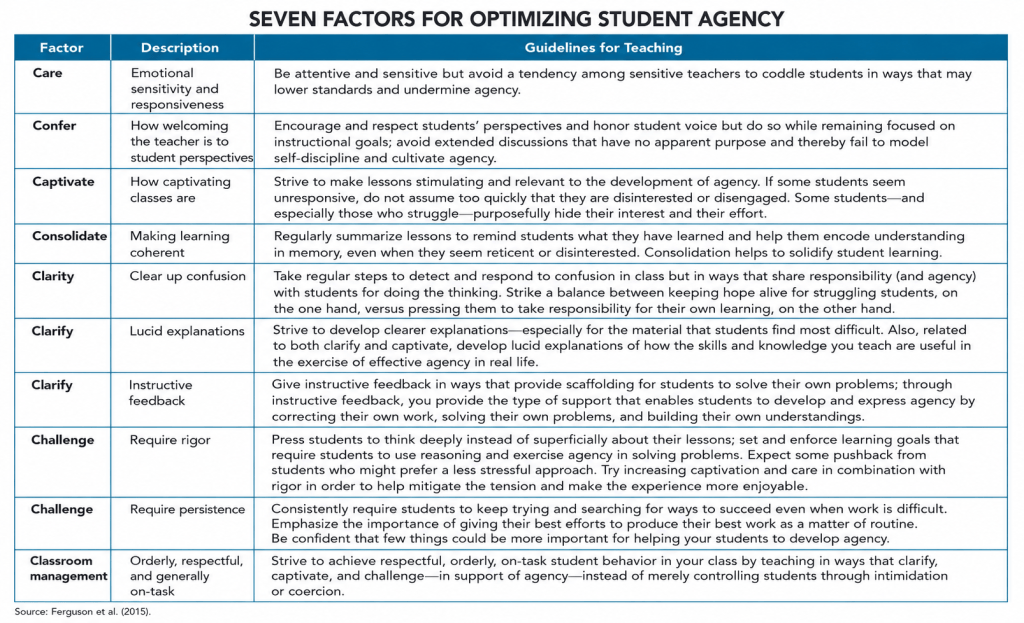
Their framework identifies several factors teachers can influence. Four seem particularly relevant to my experience with this student: clarity, challenge, persistence and instructive feedback.
What I find useful is the balance between them.
Students need challenge. Reducing expectations whenever learning becomes difficult may actually undermine opportunities to experience genuine mastery.
But challenge needs to be accompanied by clarity. Students need to understand what successful learning looks like and recognize when they are confused.
They also need to develop persistence: the expectation that difficulty is part of learning rather than evidence that they cannot succeed.
And they need instructive feedback that helps them solve problems without solving those problems for them.
This last distinction has become particularly important to me.
Supporting agency does not mean stepping away and expecting students to figure everything out independently. But it also does not mean removing every obstacle for them.
Sometimes the most useful scaffold is the one that helps a student take the next step themselves.
High Ability Does Not Mean Low Support
This has implications for how I think about high-ability students.
It can be tempting to assume that because a student has demonstrated high ability, they need less support.
I increasingly think they may need different support.
A student who previously experienced success relatively easily may encounter a very different challenge when success begins to require sustained effort, self-advocacy or persistence through uncertainty.
In those moments, lowering the challenge is not necessarily the answer.
Instead, I want to help students accumulate evidence that they can navigate difficult learning: clarify what they do not understand, seek feedback, try another approach, persist and eventually experience success.
Those experiences matter because self-efficacy develops partly through mastery experiences (Bandura, 1993). Confidence is not simply something we tell students to have. It becomes stronger when students have evidence that they can succeed.
From “I Can” to “We Can”
This also connects back to collective student efficacy.
A student who doubts their own capacity may be less willing to take intellectual risks in a group. They may defer to the student who appears to know the answer, contribute less, or keep an uncertain idea to themselves.
Conversely, classrooms can allow students to see that struggle is not uniquely theirs.
They see peers misunderstand, ask questions, revise ideas and eventually succeed. They also begin to experience how their own contributions can help others learn.
That is one reason I now see self-efficacy, agency and collective efficacy as interconnected.
Before students can confidently believe “we can learn together,” they also need experiences that allow them to believe “I have something to contribute.”
And perhaps one of the most important questions I can ask when a capable student isn’t performing is not simply:
“What can’t they do?”
but:
“What have they stopped believing they can do?”
References
Bandura, A. (1993). Perceived self-efficacy in cognitive development and functioning. Educational Psychologist, 28(2), 117–148.





Leave a Reply