
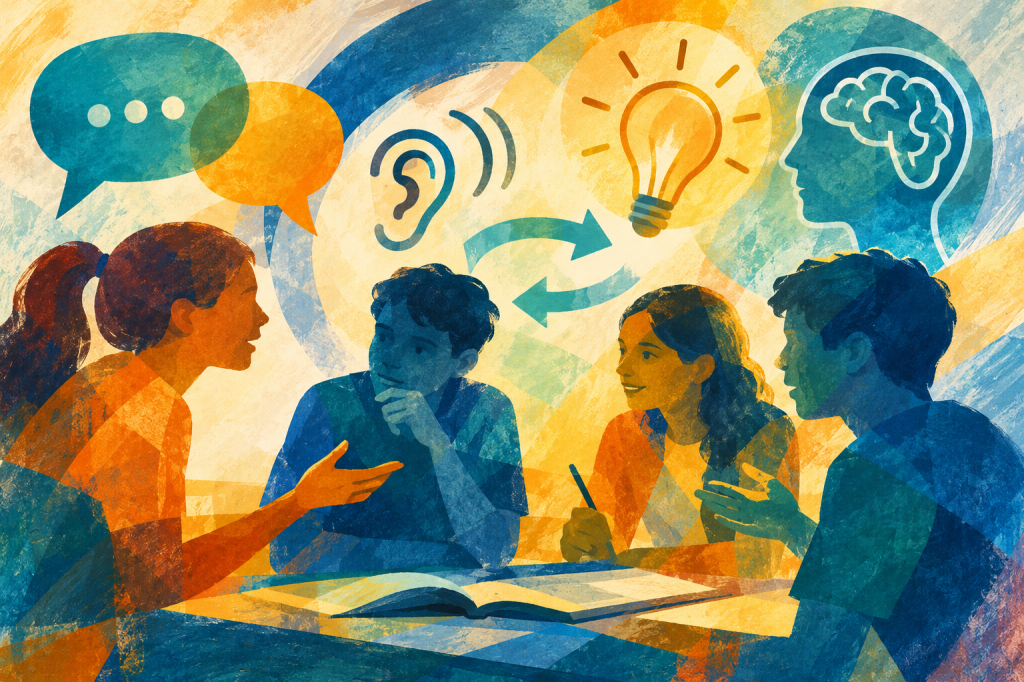
For years, I used group discussion regularly in my classroom.
I would pose a question, put students into pairs or small groups, and ask them to discuss it. Students were talking to one another, so I assumed they were collaborating.
But when I started paying closer attention to what was actually happening, I noticed something.
Often, students were taking turns speaking rather than genuinely listening. One student would offer an interpretation. Another would wait and then offer their own. Someone might agree. Occasionally, one confident student would dominate while everyone else listened.
There was plenty of talking.
I wasn’t always convinced there was much collective thinking.
That began to change when I started using structured discussion protocols. One that particularly influenced my thinking was Passport Paraphrase, a protocol I encountered through Adaptive Leadership.
The premise was simple: before contributing their own idea, students first had to paraphrase what the previous student had said.
Initially, it felt artificial.
But students could no longer simply wait for their turn to speak. They had to listen closely enough to understand and accurately represent someone else’s thinking before adding their own.
Something shifted.
The discussion became less like a sequence of individual performances and more like a conversation in which ideas were connected.
I realized that I had been focusing heavily on what I wanted students to discuss. I hadn’t spent nearly enough time teaching them how to learn from one another.
From Collaboration to Collective Efficacy
This realization has become more significant as I have learned about collective student efficacy.
Drawing on Bandura’s (2002) work on collective agency, collective efficacy moves beyond what an individual believes they can accomplish to what people believe they can accomplish together.
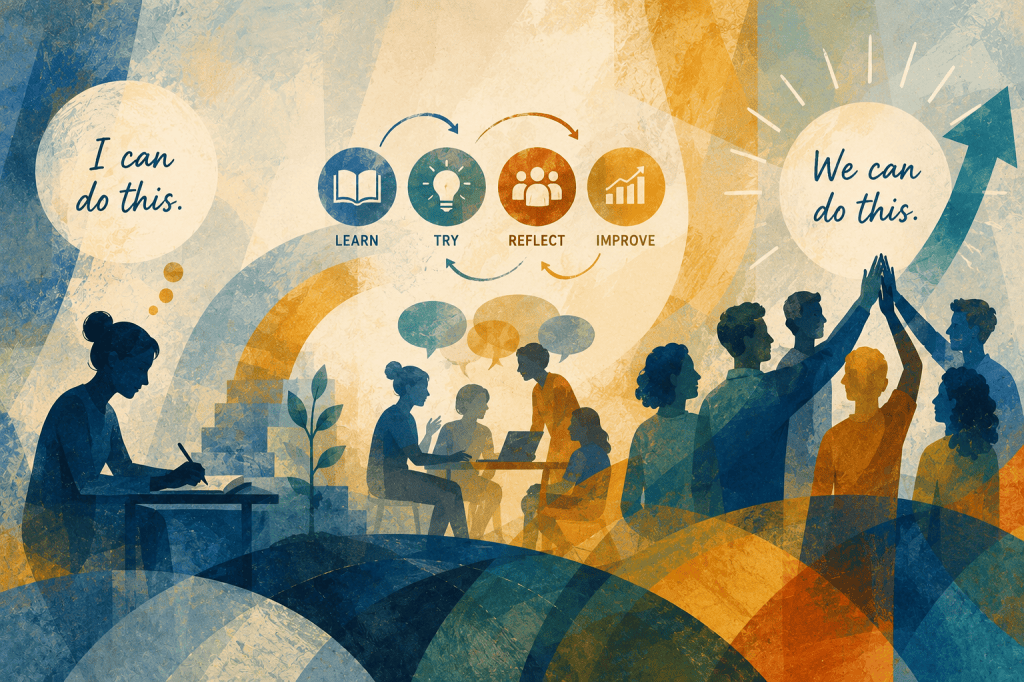
Hattie, Fisher, Frey, and Clarke (2021) apply this idea directly to students. Their concept of collective student efficacy emphasizes developing learners who can operate both independently and interdependently.
I find that distinction important.
I don’t want students to become dependent on their peers. I want them to develop their own knowledge, skills and confidence.
But I also want them to discover something else:
Sometimes I can understand something better because someone else is thinking alongside me.
That is a very different goal from simply getting students to work in groups.
“Discuss With Your Group” Is Not a Simple Instruction
I now think differently about how often I have said:
Discuss this with your group.
Hidden inside that apparently simple instruction are a remarkable number of expectations.
I am asking students to listen carefully, paraphrase, question, disagree constructively, extend someone’s thinking, tolerate uncertainty and sometimes change their minds.
Those are learned behaviours.
Yet I had sometimes assumed students would develop them naturally simply because I gave them opportunities to talk.
Passport Paraphrase helped me see the value of making those behaviours explicit.
A protocol can initially feel restrictive. But the restriction has a purpose.
It slows students down.
Listen.
Understand.
Represent someone else’s thinking.
Then contribute.
The structure makes an otherwise invisible process visible.
Structure Can Support Agency
This has also changed how I think about student agency.
It can be tempting to equate agency with freedom: give students a task, step back and allow them to determine how to engage with it.
But structure and agency are not necessarily opposites.
For a student who is already confident in academic discussion, an open conversation may be easy to navigate. For another student, it may mean sitting silently while more confident classmates take over.
A protocol provides a way in.
Wether or not they continue to use this protocol with groups in the future, over time, I want students to listen because they understand that someone else’s idea might change theirs.
I want them to ask questions because they genuinely want to understand another person’s reasoning.
I want them to disagree because testing ideas can make those ideas stronger.
And I want them to recognize that even a peer’s misunderstanding can become useful. Explaining why I disagree with someone forces me to clarify and articulate my own thinking.
Learning With and From One Another
This is where I think discussion can become something more than collaboration.
Students begin to accumulate experiences in which learning with other people genuinely improves their understanding.
They start discovering:
I don’t have to figure everything out by myself.
But perhaps just as importantly:
What I contribute can help someone else learn.
That second belief matters.
Collective efficacy isn’t simply believing that the group can help me. It means beginning to recognize that I am part of what makes the group capable.
That is what I now listen for during classroom discussions.
Are students responding to one another rather than simply taking turns?
Are ideas changing as the conversation develops?
Can I hear evidence that one student’s thinking has influenced another’s?
Are students beginning to see their peers’ ideas as resources for their own learning?
Because I no longer think students automatically know how to learn together.
We have to teach them.
And when we do, we are not simply improving classroom discussion. We are helping students experience what it means to be both independent and interdependent learners: confident in what they can contribute individually, but equally confident that sometimes we can understand more together than any of us could alone.
But believing in the group doesn’t replace believing in yourself. In fact, I have increasingly come to see the two as deeply interconnected.
References
Bandura, A. (2002). Social cognitive theory in cultural context. Applied Psychology, 51(2), 269–290.




Leave a Reply