
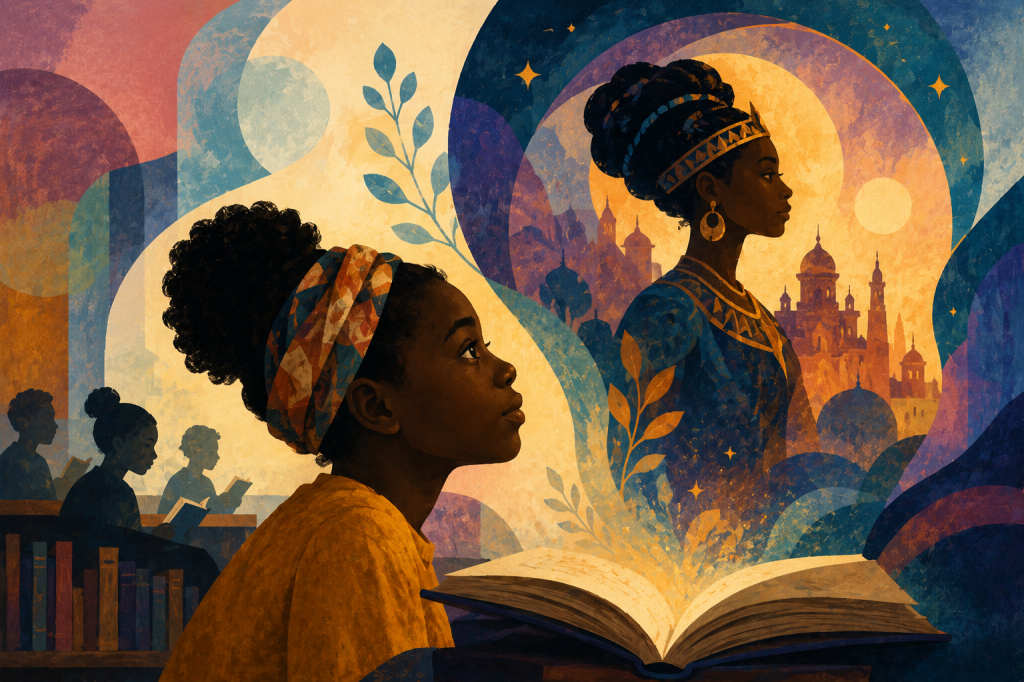
A few years ago, I read Raybearer and Redemptor by Jordan Ifueko and immediately loved them. The novels were imaginative, emotionally complex, and beautifully written. Like many middle school English teachers, I regularly shared book recommendations with my students, especially when I found stories I thought they might genuinely connect with.
So one day, I recommended the series to one of my classes.
After the lesson ended, one of my students approached me quietly. She was Kenyan, and she told me she was excited to read the books because it had only been about two years since she had first read a novel with a Black protagonist.
I remember feeling genuinely stunned.
Not because I doubted her experience, but because I realized how easily someone working within English education could underestimate how frequently many students move through reading experiences without ever truly seeing themselves reflected in stories.
That conversation stayed with me because it fundamentally shifted the way I thought about representation in literature.
Before that moment, I think I understood representation mostly intellectually. I agreed that diverse books were important. I supported expanding classroom libraries and diversifying curriculum choices. But I do not think I fully grasped the emotional weight of what it means to repeatedly encounter stories where people who look like you, speak like you, or come from similar cultural backgrounds are absent from the center of the narrative.
Representation is not symbolic.
It shapes belonging.
Research on reading engagement and identity suggests that students are more motivated to read when they can meaningfully connect to texts and see aspects of their identities reflected within them (Tatum, 2009). Literature does not simply teach literacy skills. It also communicates whose experiences are worthy of attention, empathy, and centrality.
What struck me most about that student’s comment was that she was not describing a lack of books with Black characters entirely. She was describing the rarity of Black protagonists — characters who were fully centered within the story itself.
And importantly, these books were fantasy.
That mattered too.
Fantasy has historically been dominated by white protagonists and Eurocentric worlds, particularly within children’s and young adult publishing. Diverse representation has often been concentrated within historical fiction, social issue novels, or narratives explicitly focused on oppression or trauma. But students also deserve stories where characters of color get to be heroes, leaders, adventurers, and protagonists in imaginative worlds that are not defined solely by suffering.
There is something powerful about being able to enter a fantasy world and still recognize yourself there.
At the same time, this experience complicated a phrase I had often heard throughout my teaching career:
“All students can relate to all stories.”
To some extent, that is true. Literature absolutely allows readers to develop empathy and connect across differences. Students should read broadly and encounter perspectives beyond their own experiences.
But I no longer believe that statement tells the whole story.
There is a difference between relating to a character and repeatedly seeing people like yourself centered within literature. Students who have always seen themselves represented may underestimate how affirming that visibility can feel because they have rarely experienced its absence.
Reading identities are shaped cumulatively over time. The stories students encounter repeatedly influence how they view reading itself — who books are “for,” whose lives matter within narratives, and whether literature feels emotionally accessible to them.
Research on children’s and young adult literature has increasingly highlighted how representation influences engagement, belonging, and identity development, particularly for students from historically marginalized groups (Muhammad, 2020).
That does not mean every student needs to see themselves perfectly mirrored in every text. But it does mean schools and teachers should think carefully about patterns across an entire curriculum or classroom library.
Who consistently gets centered?
Who remains peripheral?
Whose stories are treated as universal, and whose are treated as “special topics”?
Since that conversation, I have become far more intentional about the books I recommend, teach, and place into classroom libraries. Not because representation is a trend, but because students deserve access to stories that allow them to feel visible within the literary world.
Students notice whose stories are centered long before adults do.
And often, they carry that awareness quietly.
References
Muhammad, G. E. (2020). Cultivating genius: An equity framework for culturally and historically responsive literacy. Journal of Adolescent & Adult Literacy, 64(2), 215–219. 10.26522/ssj.v16i1.3397
Tatum, A. W. (2009). Reading for their life: (Re)building the textual lineages of African American adolescent males. Journal of Adolescent & Adult Literacy, 53(2), 90–99. https://doi.org/10.1598/JAAL.53.2.1






Leave a Reply