
When I first began teaching middle school, I was proud of how much freedom I gave students in my classroom. One of the things I felt particularly good about was my seating arrangement — or rather, the lack of one.
Students could sit wherever they wanted.
At the time, this felt progressive and student-centered. My classroom was lively, collaborative, and relaxed. Students naturally gravitated toward their friends, discussions flowed easily, and the room seemed to function well. I believed I was giving students agency over their own learning environment, and I saw that as a positive thing.
Then one day, after a few teachers had visited my classroom to observe a lesson, one of them casually asked me a question I was completely unprepared for:
“Did you intentionally put all the girls in the front and the boys in the back?”
I remember immediately feeling confused. Of course I had not intentionally done that.
But after school, I went back and looked carefully at the seating arrangement.
She was right.
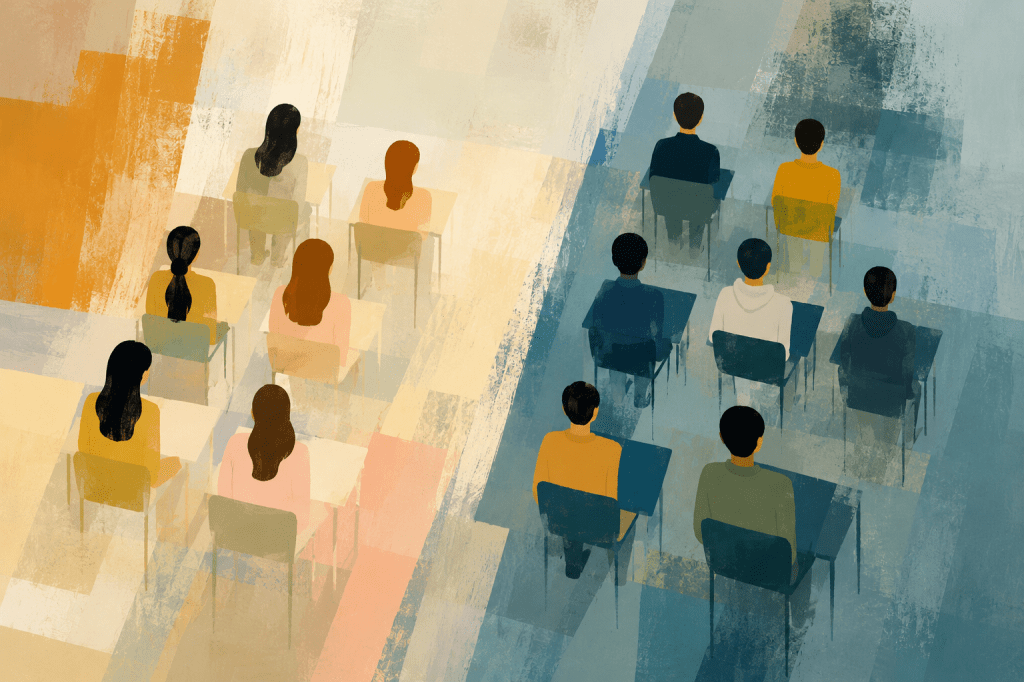
Without realizing it, my classroom had divided itself almost entirely by gender. Most of the girls were sitting near the front of the room. Most of the boys had clustered toward the back.
What unsettled me most was not the arrangement itself. It was the realization that I had not noticed it.
I had been so focused on student choice that I had failed to think critically about the patterns those choices might produce.
That moment stayed with me because it forced me to confront an uncomfortable truth about equity in classrooms: good intentions are not enough. Even environments designed to be open, flexible, and empowering can unintentionally reproduce existing social dynamics.
At the time, I viewed equality and equity as essentially interchangeable ideas. If every student had the same opportunity to choose where they sat, then the system was fair. But I began realizing that equality and equity are not always the same thing.
Equality says:
Everyone can choose.
Equity asks:
What patterns emerge from those choices, and who benefits from them?
Research has consistently shown that classroom space matters. Students seated toward the front of classrooms are often more likely to participate, engage in discussion, and receive interaction from teachers (Wannarka & Ruhl, 2008). Studies on classroom participation also suggest that social dynamics, including gender norms, can shape how students occupy learning spaces and engage in classroom discourse (Cohen et al., 2009).
What struck me afterward was how invisible these dynamics had initially been to me. Nobody in my class had complained. The students themselves likely did not consciously notice the pattern either. Yet the arrangement still carried implications about participation, confidence, visibility, and belonging.
I did not respond by eliminating student choice entirely. I still believe agency matters. Students should have opportunities to feel ownership over their classroom environment.
But I became far more intentional.
Some days, students could choose their own seating. Other days, I assigned seats strategically. Sometimes I grouped students intentionally to encourage collaboration across social groups. Other times I rotated seating arrangements to disrupt predictable patterns. I also became much more aware of who occupied classroom space most confidently and who quietly disappeared into the background.
What changed most was not my seating plan. It was my understanding of equity.
Before that moment, I think I imagined inequity as something dramatic and obvious. I associated it with major policies or overt discrimination. But increasingly, I have come to realize that equity work often lives in much smaller moments: who speaks most during discussions, whose perspectives are centered in the curriculum, who feels comfortable taking intellectual risks, and even where students sit in a classroom.
Many inequitable patterns are not created intentionally. They emerge quietly through habit, social conditioning, and systems we fail to examine closely.
That experience reminded me that classrooms are never neutral spaces. Even when we believe we are stepping back and giving students freedom, we are still shaping an environment with consequences.
And sometimes the most important equity work begins not with dramatic failures, but with quiet moments of realization.
References
Cohen, E. G., Lotan, R. A., Scarloss, B. A., & Arellano, A. R. (2009). Complex instruction: Equity in cooperative learning classrooms. Theory Into Practice, 38(2), 80–86. https://doi.org/10.1080/00405849909543836
Wannarka, R., & Ruhl, K. (2008). Seating arrangements that promote positive academic and behavioural outcomes: A review of empirical research. Support for Learning, 23(2), 89–93. https://doi.org/10.1111/j.1467-9604.2008.00375.x






Leave a Reply