
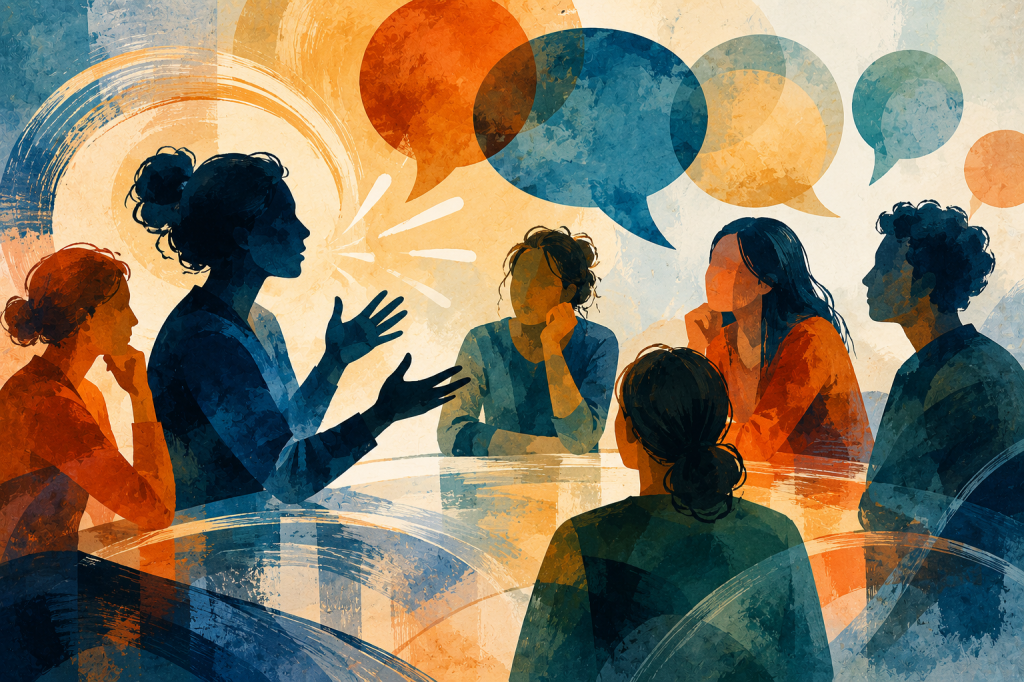
There was a collaborative meeting I facilitated several years ago that fundamentally changed the way I think about participation, facilitation, and team dynamics.
On the surface, the meeting appeared highly collaborative. People were talking, ideas were flowing, and the discussion was energetic. But as the meeting progressed, I began noticing something uncomfortable: the conversation was increasingly revolving around one voice.
One teacher spoke first almost every time a question was posed. They responded quickly, confidently, and at length. They were intelligent, experienced, and deeply invested in the work. None of their contributions were inappropriate or intentionally dismissive. In fact, much of what they said was thoughtful and valuable.
And yet, the dynamic in the room slowly shifted.
Other teachers became quieter.
Some stopped contributing altogether.
A few began nodding rather than speaking.
The discussion remained active, but participation became increasingly uneven.
At the time, I remember feeling uncertain about how to respond. Technically, the meeting was functioning. Nobody was openly disagreeing. Nobody appeared upset. The conversation was moving forward.
But I could sense that something important was being lost.
Looking back, I realize I had been operating from a simplistic understanding of collaboration. I assumed collaboration meant people talking together. If discussion was happening, I interpreted that as engagement.
What I understand now is that collaboration is not simply the presence of conversation. It is the presence of equitable participation.
Without intentional facilitation, collaboration can easily privilege confidence over collective intelligence.
That realization became even clearer after I began studying Adaptive Leadership and collaborative facilitation practices more deeply. I started noticing how naturally dominant voices can emerge within professional teams, often without malicious intent.
Sometimes dominance emerges from personality. Some individuals process externally and think by speaking.
Sometimes it emerges from expertise or experience. Teams often defer to individuals perceived as particularly knowledgeable.
Sometimes hierarchy shapes participation, even informally. Certain voices carry more influence because of reputation, tenure, or positional authority.
And sometimes silence is misinterpreted. Quieter team members may appear disengaged when, in reality, they are carefully processing, reflecting, or waiting for space to contribute.
The longer I worked in schools, the more I realized that collaborative culture does not emerge automatically simply because teachers are placed together in a room.
It requires facilitation.
Research by Amy Edmondson (1999) highlights the importance of psychological safety within teams. People are far more likely to contribute ideas, ask questions, and engage in intellectual risk-taking when they feel safe participating. In collaborative meetings, psychological safety is not only about whether people are “allowed” to speak. It is also about whether structures exist that genuinely make participation possible.
That distinction matters enormously.
A meeting can appear collaborative while still unintentionally silencing important perspectives.
This realization also changed the way I thought about facilitation as a leadership practice. Earlier in my career, I saw facilitation primarily as keeping meetings efficient and on task. Now, I see facilitation as actively shaping participation patterns within the room.
Who is speaking most frequently?
Whose ideas are being built upon?
Who has not contributed yet?
Who may need more processing time?
Whose expertise is unintentionally dominating the conversation?
These are facilitation questions, not just interpersonal ones.
The work of Ronald Heifetz on Adaptive Leadership also influenced my thinking significantly. Heifetz argues that leaders must learn to regulate productive disequilibrium within groups rather than immediately resolving tension or controlling discussion (Heifetz & Linsky, 2002). I began realizing that equitable collaboration often requires intentionally slowing conversations down rather than allowing the fastest or most confident thinkers to dominate them.
This is where protocols became transformative in my own leadership practice.
Initially, I resisted structured discussion protocols because they felt artificial to me. I worried they would make conversations rigid or overly procedural. But over time, I realized that protocols often create the very conditions necessary for authentic collaboration.
Without structure, participation frequently defaults to the loudest, fastest, or most confident voices.
With thoughtful structures, more perspectives become visible.
Some of the strategies that have significantly changed my own facilitation include:
- Round-robin sharing before open discussion
- Silent writing or reflection time before verbal responses
- Structured protocols with defined participation routines
- Intentionally tracking equity of voice
- Using wait time instead of immediately filling silence
These small shifts can fundamentally alter the quality of collaborative discussion.
I have also become increasingly influenced by the work of Neil Mercer on exploratory talk. Mercer argues that meaningful dialogue depends on participants jointly engaging with ideas, questioning assumptions, and building collective understanding together rather than simply asserting individual opinions (Mercer, 2000). That kind of dialogue requires conversational conditions where multiple voices can genuinely participate.
And that rarely happens accidentally.
What I now understand is that collaboration is not simply about gathering intelligent people in the same room. Even highly skilled teams can unintentionally reproduce participation inequities if facilitation remains passive.
Good collaboration is designed.
It is shaped through norms, protocols, pacing, and intentional facilitation. It depends on leaders recognizing that participation is not naturally equitable simply because everyone has technically been invited to the meeting.
The older I get as a leader, the more I realize that some of the most important work in collaborative spaces involves protecting the voices that are easiest to lose.
References
Edmondson, A. (1999). Psychological safety and learning behavior in work teams. Administrative Science Quarterly, 44(2), 350–383. https://doi.org/10.2307/2666999
Heifetz, R. A., & Linsky, M. (2002). Leadership on the line: Staying alive through the dangers of leading. Harvard Business School Press.
Mercer, N. (2000). Words and minds: How we use language to think together. Routledge.






Leave a Reply