
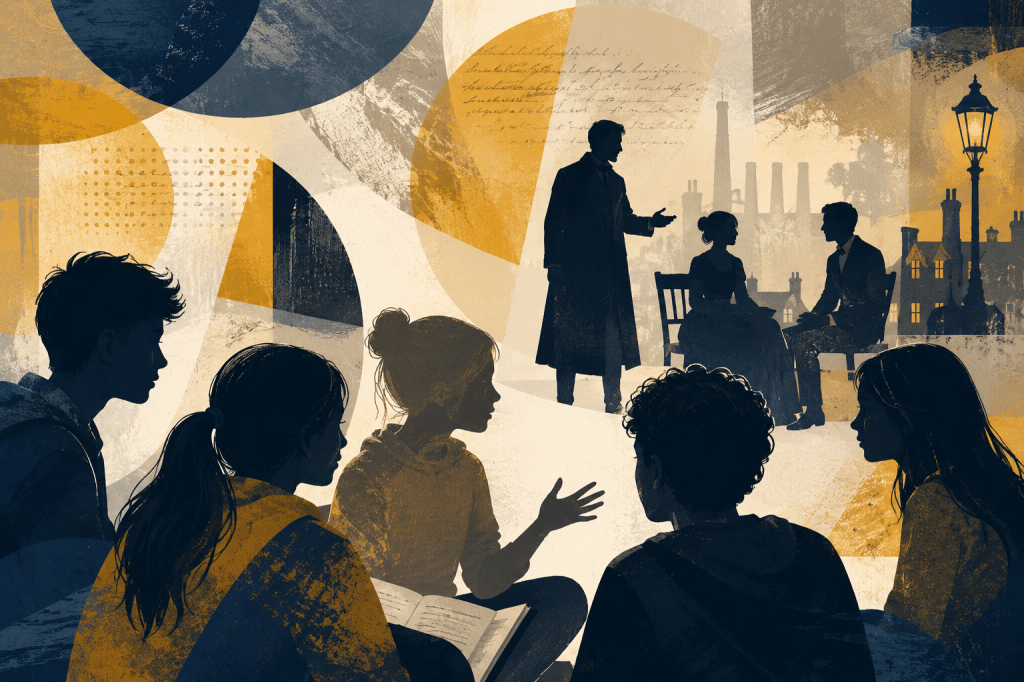
A few years ago, I taught An Inspector Calls to a Grade 8 class.
On paper, it looked like a risky choice. The play deals with class inequality, exploitation, moral responsibility, generational conflict, and social hypocrisy. It is deeply tied to the political and economic realities of early twentieth-century Britain. The language is unfamiliar to many students. The dramatic irony depends heavily on historical context. It would have been easy to conclude that the text was simply too difficult for middle school readers.
But the discussions we had were some of the strongest I have experienced in a Grade 8 classroom.
Students debated whether the Birling family deserved sympathy. They argued over whether the Inspector represented justice, guilt, socialism, or conscience itself. They noticed pauses in dialogue, shifts in tone, and the way Priestley structured dramatic tension to expose power and privilege. They gasped at the twists and reversals. Some students became angry with the characters. Others defended them passionately.
Nearly all of them were engaged.
The experience changed how I think about difficult texts.
The lesson was not that Grade 8 students are automatically ready for everything. The lesson was that students are often ready for far more than we assume, if we teach the context carefully enough to help them make meaning.
For a long time, conversations about rigor in literacy instruction have often drifted toward simplification. If students struggle with a text, the instinct is sometimes to replace it with something easier, shorter, or more immediately accessible. There are understandable reasons for this. Teachers want students to feel successful. Engagement matters. Access matters.
But there is an important distinction between removing barriers and removing complexity.
Students do not necessarily need simpler ideas.
Often, they need stronger scaffolds.
Before reading the play, we spent time building historical and social context. We discussed the British class system, industrialization, gender expectations in the early 1900s, and the aftermath of the First World War. We explored why Priestley wrote the play in 1945 while setting it in 1912. We unpacked dramatic irony and social responsibility before students were expected to independently analyse them within the text itself.
This preparation mattered enormously.
Once students had enough contextual knowledge, the play became far more accessible. Dialogue that initially felt distant or confusing suddenly carried tension and meaning. Characters’ choices became interpretable rather than arbitrary. Students could situate the moral arguments within a broader social framework instead of reading the play as a disconnected family drama.
I increasingly think this is one of the most misunderstood aspects of reading comprehension.
Difficulty is not always located within the text itself. Sometimes difficulty emerges because students lack the knowledge structures needed to interpret what they are reading. When those structures are built deliberately, students are often capable of much deeper analysis than we initially predict.
This is one reason why collaborative discussion matters so much when teaching difficult texts.
In a practical article on supporting adolescent readers, Sara Yergler recommends strategies such as readers’ theatre, small-group discussion, and structured talk routines to help students enter challenging literary texts. Those approaches resonated strongly with what I observed in the classroom. Hearing the dialogue aloud changed students’ comprehension significantly. Priestley’s manipulation of tension, interruption, and emotional pacing became much more visible once students performed scenes rather than silently reading them.
Discussion also became a form of scaffold itself.
Students often clarified ideas collaboratively before they could articulate them independently in writing. Interpretations evolved socially through disagreement, questioning, and textual evidence.
Research supports the value of this kind of dialogic instruction. Patricia K. Murphy and colleagues (2009), in a meta-analysis examining classroom discussion and reading comprehension, found that discussion-based approaches positively influenced students’ understanding of texts. Similarly, Ian A. G. Wilkinson and colleagues (2017) found that dialogue-intensive pedagogies support deeper reasoning when students collaboratively justify and develop interpretations rather than simply search for predetermined answers.
What stood out most during our study of An Inspector Calls was not simply that students understood the text.
It was that they cared about it.
The moral ambiguity generated genuine emotional and intellectual investment. Students wanted to debate responsibility. They wanted to revisit scenes after discussions changed their perspectives. The complexity itself became motivating.
This experience reshaped how I think about rigor.
Too often, we underestimate students because we confuse familiarity with accessibility. A text that feels culturally distant or historically unfamiliar may initially appear inaccessible, but accessibility can be built through knowledge, modelling, discussion, and careful scaffolding.
Avoiding complex texts altogether may unintentionally narrow students’ opportunities to build empathy, historical understanding, disciplinary thinking, and interpretive confidence.
Of course, this does not mean every difficult text belongs in every classroom. Text selection still requires professional judgment and sensitivity to students’ developmental readiness. But rigor should not automatically be treated as harmful, nor should productive struggle be mistaken for failure.
Increasingly, I think one of the central responsibilities of literacy instruction is not simplifying the world for students.
It is helping students build the knowledge, context, and confidence necessary to navigate complexity within it.
And often, they are capable of far more than we expect.
References
Murphy, P. K., Wilkinson, I. A. G., Soter, A. O., Hennessey, M. N., & Alexander, J. F. (2009). Examining the effects of classroom discussion on students’ comprehension of text: A meta-analysis. Journal of Educational Psychology, 101(3), 740–764. https://doi.org/10.1037/a0015576
Wilkinson, I. A. G., Murphy, P. K., & Binici, S. (2017). Dialogue-intensive pedagogies for promoting reading comprehension: What we know, what we need to know. Elementary School Journal, 117(2), 281–304. https://doi.org/10.1086/690898






Leave a Reply