
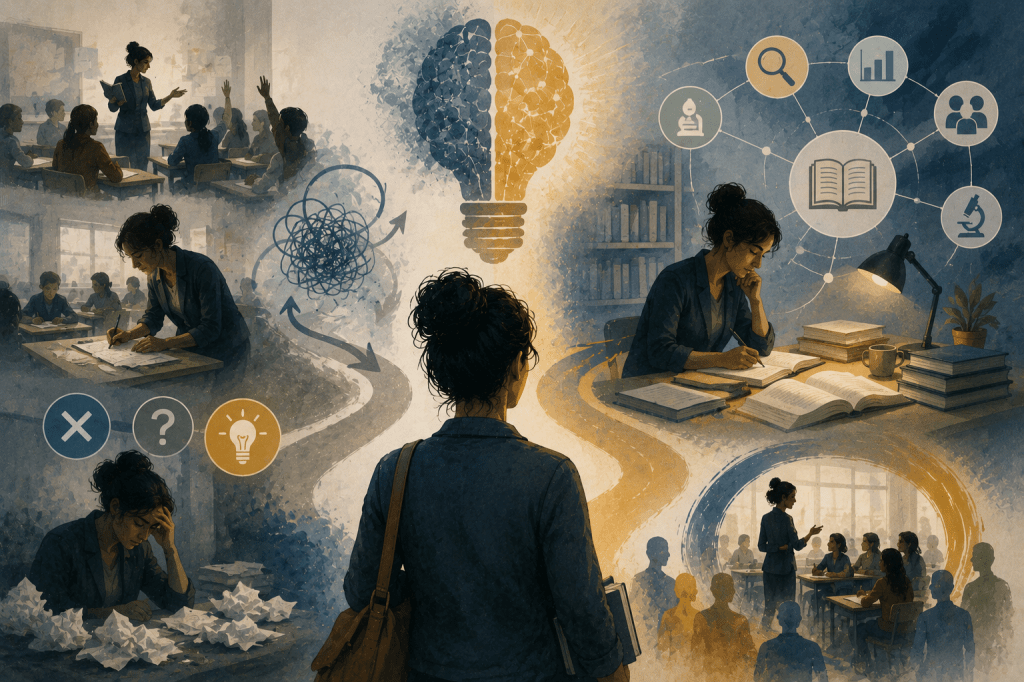
When I first began teaching, I believed experience was the most important factor in becoming effective. The logic seemed obvious: the more lessons I taught, the more students I worked with, and the more challenges I faced, the better teacher I would become. Experience felt like the ultimate teacher.
And to a degree, it was.
Early in my career, I experimented constantly. I adjusted seating plans, changed discussion protocols, redesigned assessments, and tried different ways of teaching reading and writing. Some approaches worked immediately. Others failed completely. At the time, I viewed this process as the natural progression of becoming a better teacher: trial, error, adaptation.
Then I began my Master’s degree.
What surprised me most was not simply the amount of educational research that existed, but how much of it directly challenged assumptions I had developed through experience alone. Some practices I believed were effective had limited evidence behind them. Others I had dismissed too quickly were strongly supported by decades of research. At the same time, I encountered entirely new ideas that transformed how I understood teaching and learning.
Research did not replace experience. It reframed it.
I began to realize that experience alone can reinforce ineffective habits just as easily as effective ones. Without reflection and external evidence, teachers may simply become more efficient at practices that are not producing the best outcomes for students. Experience matters deeply, but it is not automatically synonymous with expertise.
This realization connects closely to the idea of intelligent failure. According to Amy Edmondson (2023), intelligent failure occurs when people take thoughtful risks in new territory, informed by prior knowledge, with the goal of generating learning. These are not careless mistakes. They are productive attempts that expand understanding.
That idea resonated with me immediately because teaching constantly places educators in unfamiliar territory. Every class is different. Every group of students responds differently. Even experienced teachers routinely encounter situations where established routines no longer work. The question is not whether failure will occur, but whether we learn from it intelligently.
Educational research reinforces this idea. Manu Kapur (2008) found that students who initially struggle and fail while attempting to solve complex problems often develop deeper conceptual understanding later compared to students who are directly shown procedures first. Productive struggle, when structured carefully, can strengthen learning rather than hinder it.
Similarly, research by Janet Metcalfe (2017) demonstrates that making and correcting errors can significantly improve long-term retention and understanding. Errors themselves are not inherently negative. In many cases, they are essential to learning.
As I reflected on these ideas, I realized they applied just as much to teachers as they do to students.
Many of my early “mistakes” as a teacher were actually forms of productive experimentation. Some lessons failed because I lacked sufficient understanding of learning science. Others failed because I was trying to adapt instruction to meet complex student needs. But those experiences became significantly more valuable once they were paired with research and structured reflection.
That was the major shift in my thinking:
From:
“Experience is the best teacher.”
To:
“Experience, research, and reflection together develop expertise.”
Research accelerates professional growth because it allows educators to learn not only from their own experiences, but from decades of accumulated knowledge across thousands of classrooms. Without research, some insights might take years to discover independently. Others may never emerge at all because ineffective habits can feel successful in the moment.
This has also changed how I think about leadership.
Educational leaders cannot rely solely on instinct, tradition, or personal experience. Strong leadership requires bridging research and practice. It requires creating cultures where experimentation is encouraged, where thoughtful mistakes are treated as opportunities for learning, and where professional dialogue is grounded in evidence rather than preference alone.
The goal is not perfection. The goal is continual refinement.
Good teaching is not simply experience. It is informed practice shaped through inquiry, evidence, reflection, and the willingness to learn from intelligent failure.
References
Edmondson, A. C. (2023). Right kind of wrong: The science of failing well. Atria Books.
Kapur, M. (2008). Productive failure. Cognition and Instruction, 26(3), 379–424. https://doi.org/10.1080/07370000802212669
Metcalfe, J. (2017). Learning from errors. Annual Review of Psychology, 68, 465–489. https://doi.org/10.1146/annurev-psych-010416-044022





Leave a Reply