
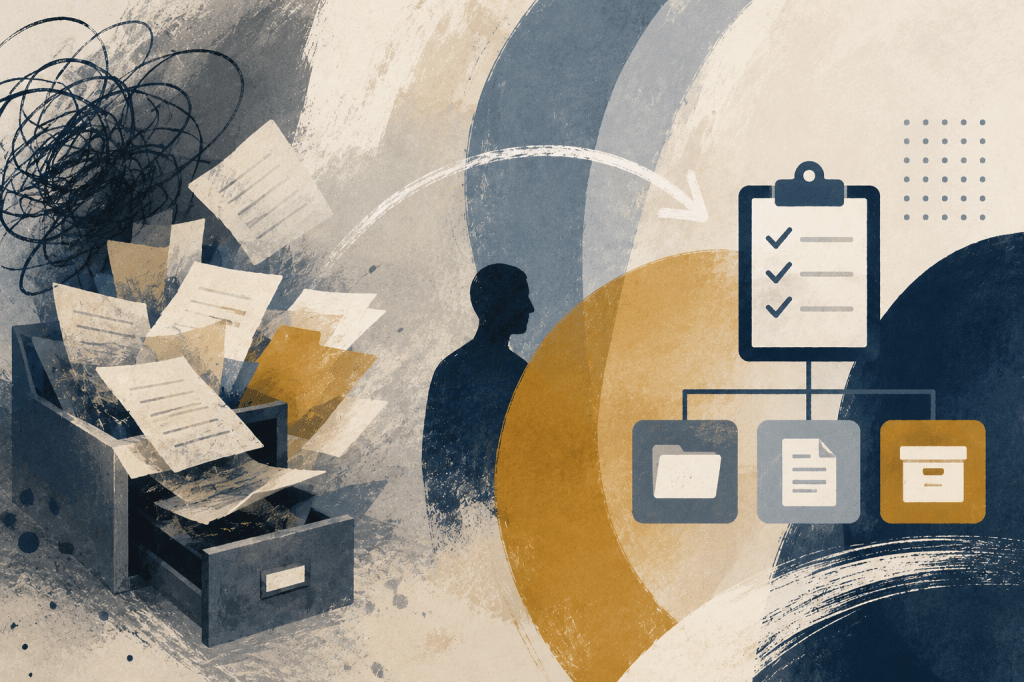
In my first year of teaching, I lost every single student medical form.
Not one or two. All of them.
I remember the moment clearly. I stood in front of a stack of empty folders, retracing my steps, opening drawers I had already checked, hoping something would reappear. It did not. Eventually, I had to do the only thing left. I sent them home again and asked families to fill them out a second time.
It was embarrassing. It felt careless. And it was entirely avoidable.
At the time, I treated it as a personal failure. I told myself I needed to be more organized, more careful, more “on top of things.” I assumed this was about me not being good enough at the administrative side of teaching, the part no one really prepares you for but everyone expects you to manage.
So I tried to fix myself. I paid more attention. I worked harder. I worried more.
But nothing fundamentally changed.
Looking back, this was what Amy Edmondson describes as a basic failure. These are failures that are predictable and preventable (Edmondson, 2023). There was no system for collecting, tracking, or storing those forms. No checklist. No routine. No clear process from “handed out” to “filed securely.” The outcome was not surprising. It was inevitable.
The shift for me was simple but important. I stopped asking, “What is wrong with me?” and started asking, “What is missing from the system?”
This way of thinking aligns with improvement science. Anthony Bryk and colleagues argue that persistent problems are often rooted in system design rather than individual performance (Bryk et al., 2015). When a problem recurs, the most effective response is to examine and redesign the process that produced it.
Edmondson’s earlier work reinforces this idea. When people are expected to produce results without clear structures, errors are more likely and learning is limited (Edmondson, 1999). Systems do not remove responsibility, but they make success more reliable.
What this means for your classroom
Teaching relies on systems that often remain invisible until they break. How we collect work, track information, and organize materials shapes daily classroom functioning.
A few practical shifts:
- Build simple, repeatable routines early
- Make processes visible rather than relying on memory
- When something goes wrong, map the process before assigning blame
- Treat recurring problems as design issues, not personal shortcomings
The goal is not to avoid all mistakes. The goal is to ensure that the same mistake does not happen twice for the same reason.
Losing those forms taught me that some failures are built into the systems we create, or fail to create. But not all failures are about systems. Sometimes, the structure is there, and the challenge is skill. In the next post, I will share a moment when a colleague walked into my classroom, assumed I was not even present, and called out the lack of control, only to realize I was sitting in the back.
References (APA 7th edition)
Bryk, A. S., Gomez, L. M., Grunow, A., & LeMahieu, P. G. (2015). Learning to improve: How America’s schools can get better at getting better. Harvard Education Press.
Edmondson, A. C. (1999). Psychological safety and learning behavior in work teams. Administrative Science Quarterly, 44(2), 350–383.
Edmondson, A. C. (2023). Right kind of wrong: The science of failing well. Atria Books.






Leave a comment