

In many schools, collaboration is something we talk about constantly. We schedule meetings for it. We build it into timetables. We even design templates to guide it. And yet, if I am honest, I have often left these meetings wondering: Was that actually collaboration?
As a middle leader, I find myself returning to a few persistent questions. What makes a meeting truly collaborative? How do I cultivate a culture where teachers feel comfortable discussing student learning together? And as a classroom teacher, how do I avoid the feeling that I am teaching in isolation, analyzing my own students’ data without the collective insight of my colleagues?
Recently, a teacher from another school mentioned that their team had begun using the Professional Learning Community (PLC) framework and consistently referred to “the guiding questions.” That comment made me pause. I had heard the term PLC many times before, but I realized that I had never really stopped to ask what it actually meant in practice.
Richard DuFour, one of the most influential writers on PLCs, notes that the term has become so widely used in education that it risks losing its meaning. Schools often use it to describe almost any group of educators working together. But simply meeting together does not automatically create a professional learning community.
At its core, a PLC is a group of educators who collaborate regularly to improve teaching and learning. The critical shift, according to DuFour (2004), is moving from a focus on teaching to a focus on learning. In other words, the central question becomes not “Did we teach it?” but “Did students actually learn it?”
Researchers generally describe PLCs through a few shared principles.
First, PLCs maintain a focus on student learning. DuFour argues that schools often assume teaching automatically leads to learning, but PLCs challenge educators to examine whether students truly master the intended outcomes.
Second, PLCs emphasize collaborative inquiry into practice. Rather than working in isolation, teachers analyze student work, assessments, and instructional strategies together. Little (1990) observed that when teachers engage in deeper forms of professional dialogue about instruction, collaboration begins to influence classroom practice.
Third, PLCs rely on evidence and reflection. Teachers regularly examine data about student learning and adjust their instruction accordingly. This idea connects closely to research on data-informed decision making and collaborative inquiry in schools (Vescio, Ross, & Adams, 2008).
Finally, PLCs promote shared responsibility for student outcomes. In traditional school structures, teachers often feel responsible only for the students in their own classrooms. In a PLC, the team collectively takes ownership of whether students learn.
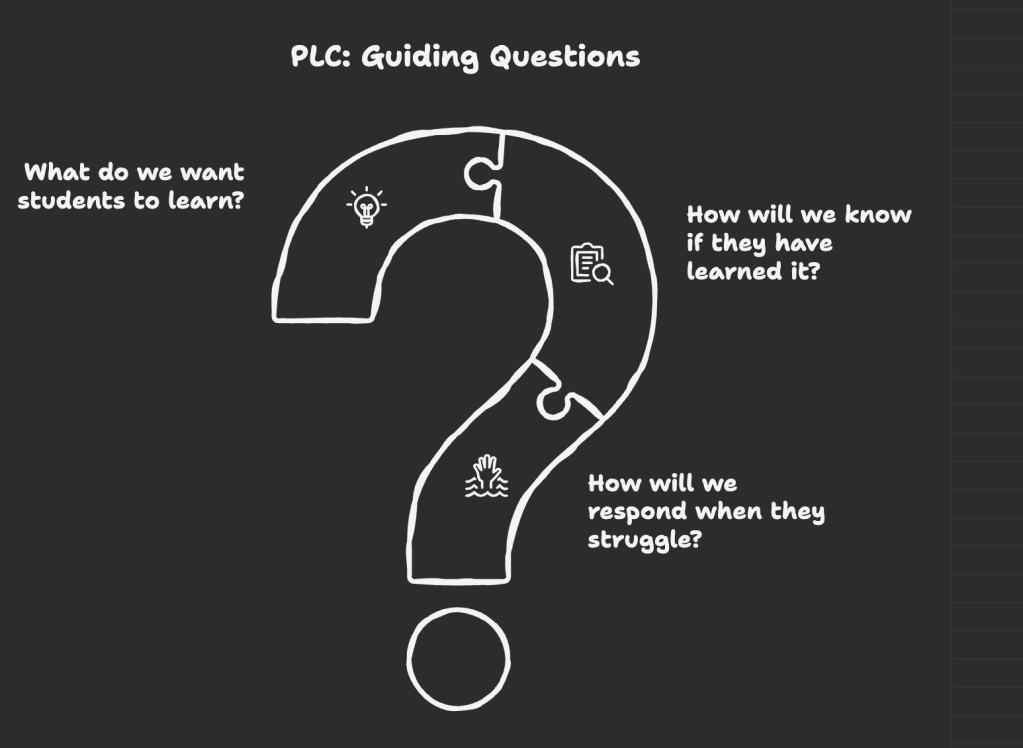
DuFour (2004) captures this collaborative process through three guiding questions:
What do we want students to learn? How will we know if they have learned it? And how will we respond when they struggle? These questions push teacher conversations beyond logistics and toward a deeper examination of learning.
Importantly, PLCs are also defined by what they are not. They are not administrative meetings, planning sessions focused only on pacing, or informal conversations that never connect back to student learning. While those activities may have value, they do not represent the kind of professional dialogue that transforms teaching practice.
As I continue to reflect on this framework, I realize that understanding the concept of PLCs is only the beginning. As a Head of Secondary English Language and Literature, I need to better understand the research behind them. What benefits do PLCs actually produce for teachers and students? How do we know when they are working?
How does collaboration work in your school? I would be interested to hear your experiences. In the next post, I will explore what the research says about the benefits of professional learning communities and how we might measure their impact.
References
DeFour, R. (2004). What Is a “Professional Learning Community”? Educational Leadership, 61(8), 6–11.
Little, J. W. (1990). The Persistence of Privacy: Autonomy and Initiative in Teachers’ Professional Relations. Teachers College Record: The Voice of Scholarship in Education, 91(4), 509–536. https://doi.org/10.1177/016146819009100403
Vescio, V., Ross, D., & Adams, A. (2008). A review of research on the impact of professional learning communities on teaching practice and student learning. Teaching and Teacher Education, 24(1), 80–91. https://doi.org/10.1016/j.tate.2007.01.004


 Research for Teachers
Leave a comment