
Last year, a colleague of mine — let’s call her Sara — confided in me during a department meeting. “I know morphology is a big part of reading research,” she said. “I just don’t see how breaking down word parts fits into a high school English class. My students can barely keep up with the texts.”
Fast forward six weeks into the term, and Sara was raving. “We just did a quick root analysis of ‘benevolent’ before reading Of Mice and Men. A student blurted out, ‘Oh! So if bene means good, maybe he’s not as kind as we think — he just wants something!’” The class ran with it. That one moment of morphological analysis unlocked a deeper understanding of Steinbeck’s characters and changed Sara’s teaching approach.
Why Morphology Matters in the Secondary Classroom
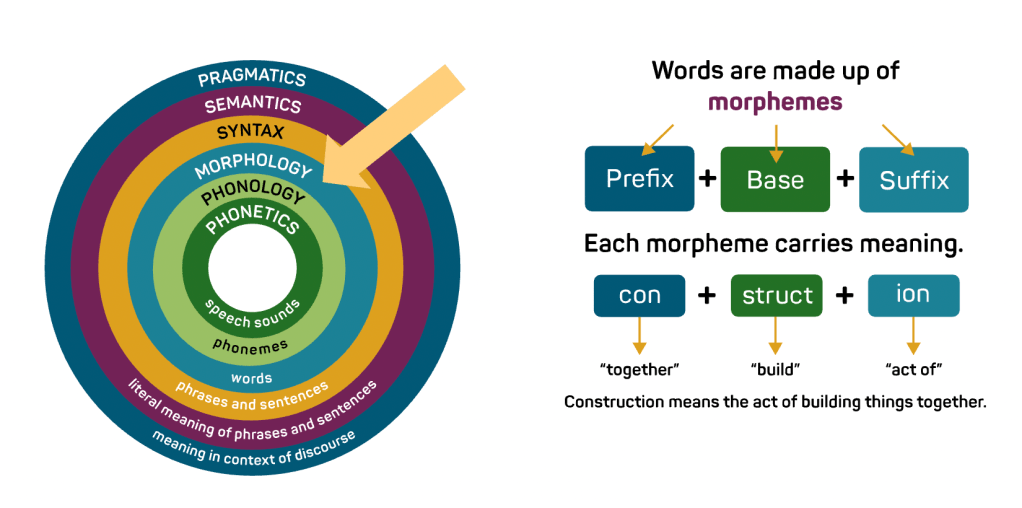
As vocabulary becomes more academic, it becomes more complex across the disciplines. As a result, secondary students face increasing difficulty accessing texts (Hendrix & Griffin, 2017). Morphological awareness (understanding how roots, prefixes, and suffixes build meaning) isn’t just about vocabulary. It’s about empowering students to decode, infer, and engage more deeply with text.
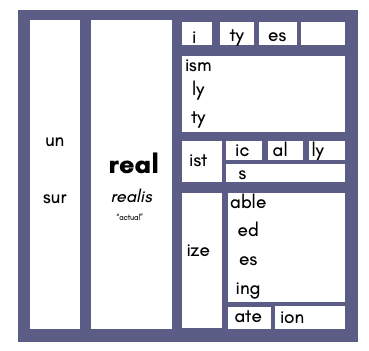
Consider this: 60–80% of words in middle and high school texts are morphologically complex (Pacheco & Goodwin, 2013). Teaching students to recognize and play with word parts helps them unlock the meaning of unfamiliar vocabulary, improves spelling, and boosts reading comprehension (Nagy et al., 2006; Goodwin et al., 2013).
Why Morphology Can Be Hard to Teach
Despite the research, morphology often gets sidelined. Why?
- It feels elementary. Many high school teachers associate word study with primary classrooms. This is contrary to studies that indicate increased morphological awareness leads to enhanced vocabulary and spelling development well into later adolescence (i.e. Graves et al., 2011).
- There’s pressure to “cover content.” Teachers feel there’s no time to “pause for prefixes.” Hendrix and Griffin (2017) suggest two different approaches. Teachers often associate “teaching morphology” with explicit instruction in morphological strategies. However, using authentic texts to engage in morphology focused tasks is also powerful. Here is an excellent source which further defines this (The Six Shifts, 2024).
- It’s misunderstood. Morphology is more than memorizing roots—it’s about critical thinking and linguistic problem-solving (i.e. the four morphological approaches presented by Pacheco and Goodwin (2013))
The Power of Morphological Awareness
Morphological instruction benefits students in ways that extend far beyond vocabulary tests:
- Improved Reading Comprehension: Students use morphemes as context clues, leading to better understanding of complex texts (Goodwin & Ahn, 2010).
- Stronger Spelling: Analyzing word parts supports phonological knowledge and pattern recognition (Goodwin & Ahn, 2010).
- Cross-Curricular Transfer: Morphological knowledge supports science, history, and even math. Terms like photosynthesis or autocracy often challenge students (Apel & Henbest, 2016).
- Empowered Learners: Poor phonological awareness is a common characteristic of students who struggle with reading comprehension (Bowers et al., 2010). When students feel less intimidated by unfamiliar words, they become more willing to take academic risks (Nagy et al, 2003).
Practical Strategies for Teaching Morphology in Secondary
Based on the instructional framework by Hendrix and Griffin (2017), here’s how teachers can integrate morphology meaningfully:
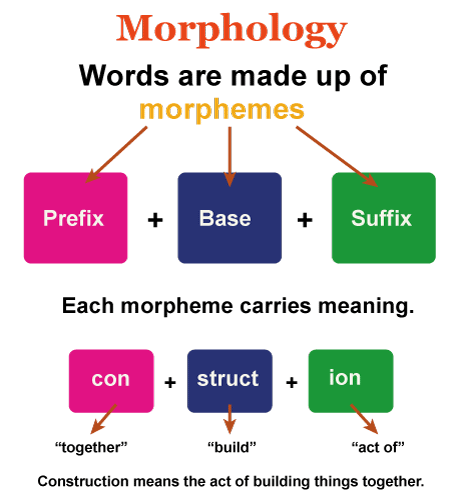
1. Mini-Lessons with Purpose
Dedicate 10–20 minutes to explicit strategy instruction. For example:
- Part-to-Whole: Break apart dehydration → de- (remove), hydr- (water), -tion (noun).
- Analogy: Compare transport to transpose → “trans” means “across.”
Use words drawn from current texts to make it immediately relevant.
2. Think-Alouds
Model your thought process while reading:
“Hmm… preposterous. I see pre- and post-. That’s confusing—how can something be before and after? Maybe it means something ridiculous or out of order. Let me reread that sentence…”
This metacognitive modeling makes the invisible visible.
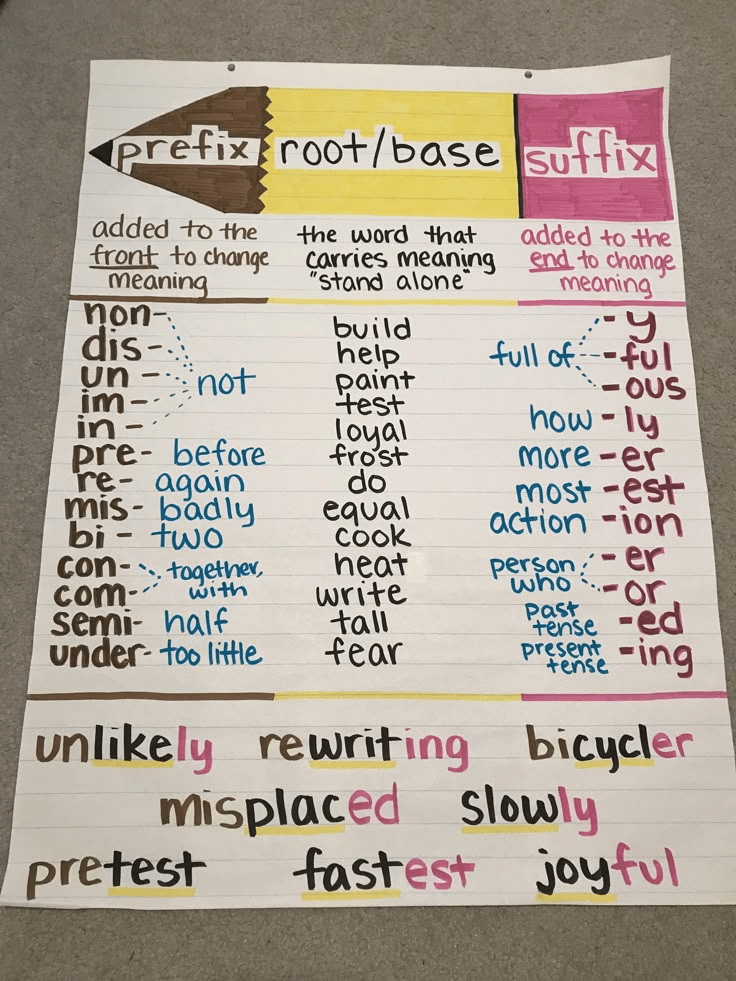
3. Anchor Charts
Yes – even in high school. Use colorful posters to track roots, affixes, and student-discovered words. Let students contribute to building the chart over time.
4. Celebrate Morphology in the Wild
When students notice -ology in mythology or -ism in capitalism, stop and celebrate! Reinforce curiosity and show how morphology pops up everywhere.
5. Use Multimodal Texts and Tech Tools
Tools like the Online Etymology Dictionary or Google Slides for collaborative word studies can make morphology engaging and inquiry-based.
Final Thoughts: A Shift in Perspective
Morphology isn’t just for elementary spelling tests. It’s a sophisticated, transferable skill. This skill helps adolescent learners build meaning from the inside out. Sara found that when students view words as puzzles, they sharpen their reading skills. They read with fuller minds.
Teaching morphology is not a detour from deep reading. It’s the bridge to it.
References
Apel, K., & Henbest, V. S. (2016). Morphological awareness intervention with kindergarteners and first- and second-grade students from low socioeconomic status homes: A feasibility study. Language, Speech, and Hearing Services in Schools, 47(3), 179–192. https://doi.org/10.1044/2016_LSHSS-15-0055
Bowers, P. N., Kirby, J. R., & Deacon, S. H. (2010). The effects of morphological instruction on literacy skills: A systematic review of the literature. Review of Educational Research, 80(2), 144–179. https://doi.org/10.3102/0034654309359353
Goodwin, A. P., & Ahn, S. (2010). A meta-analysis of morphological interventions: Effects on literacy achievement of children with literacy difficulties. Annals of Dyslexia, 60(2), 183–208. https://doi.org/10.1007/s11881-010-0041-x
Goodwin, A. P., Gilbert, J. K., & Cho, S. (2013). Morphological contributions to adolescent word reading: An item response approach. Reading Research Quarterly, 48(1), 39–60. https://doi.org/10.1002/rrq.037
Graves, M. F., Juel, C., Graves, B. B., & Dewitz, P. (2011). Teaching reading in the 21st century: Motivating all learners (5th ed.). Pearson.
Hendrix, R. A., & Griffin, R. A. (2017). Developing enhanced morphological awareness in adolescent learners. Journal of Adolescent & Adult Literacy, 61(1), 55–63. https://www.jstor.org/stable/26630711
Nagy, W., Berninger, V. W., & Abbott, R. D. (2006). Contributions of morphology beyond phonology to literacy outcomes of upper elementary and middle-school students. Journal of Educational Psychology, 98(1), 134–147. https://doi.org/10.1037/0022-0663.98.1.134
Nagy, W., Carlisle, J., & Goodwin, A. (2003). Morphological knowledge and literacy acquisition. Journal of Learning Disabilities, 36(2), 144–158. https://doi.org/10.1177/00222194030360020501
Pacheco, M. B., & Goodwin, A. P. (2013). Putting two and two together: Middle school students’ morphological problem-solving strategies for unknown words. Journal of Adolescent & Adult Literacy, 56(7), 541–553. https://doi.org/10.1002/JAAL.181
Page, R. [@rachelpage]. (n.d.). [Image post on teaching morphology] [Pinterest post]. Pinterest. https://jp.pinterest.com/pin/16607092362397521/
Reading Horizons. (n.d.). What is morphology and why does it matter? https://readinghorizons.com/blog/what-is-morphology-and-why-does-it-matter/
T-Point Tech. (n.d.). Morphology definition. https://www.tpointtech.com/morphology-definition
The Six Shifts. (2024, January). How to teach morphology instruction. https://thesixshifts.com/2024/01/how-to-teach-morphology-instruction/
Tolman, C. (2020, October 5). What is morphology and why should we care? [Video]. YouTube. https://www.youtube.com/watch?v=93sK4jTGrss



 Research for Teachers
Leave a comment