

It was 3:12 p.m. on a rainy Thursday when Sara finally closed the door of her Year 9 classroom and let herself breathe. She’d just spent her lunch break and planning period writing a detailed response to a parent complaint. The accusation? That her lesson on power dynamics in Animal Farm had made their child “feel attacked.”
This wasn’t the first time.
Earlier that week, the same student had walked out mid-discussion. No warning. No explanation. And now the parent was demanding a meeting—with admin present.
Sara had emailed her vice-principal, attaching the complaint, asking for support. The response came quickly: “Handle it directly with the parent. Let me know how it goes.”
She stared at the email, her pulse rising.
No backup. No acknowledgment of the situation’s emotional toll. Just more work, more emotional labour, and no room to exhale.
That night, as she tried to finish marking thirty essays and respond to student emails, her chest felt tight. Her own daughter was coughing in the next room. Sara didn’t have the mental energy to go check on her.
By the end of the week, she was Googling “teacher burnout signs” during a staff meeting.
The Danger of Stress
It is no surprise that research backs up the claim that teaching is a stressful job (Naghieh et al., 2015). While some stress, known as eustress, can be motivating (Selye, 1976), stress that is overwhelming can severely impact mental health. This is particularly true for those who can’t cope. In these cases, stress will lead to depression, sickness, or burnout (Cedoline, 1982).
Teacher stress is specific to their occupation. It can be defined as “a teacher’s unpleasant, negative emotions.” These emotions include anger, anxiety, tension, frustration or depression. (Kyriacou, 2001, p. 28) These emotions result from some aspect of their work as a teacher. They can affect their physical health. Their emotional and mental health can also be impacted.
Teacher Stress
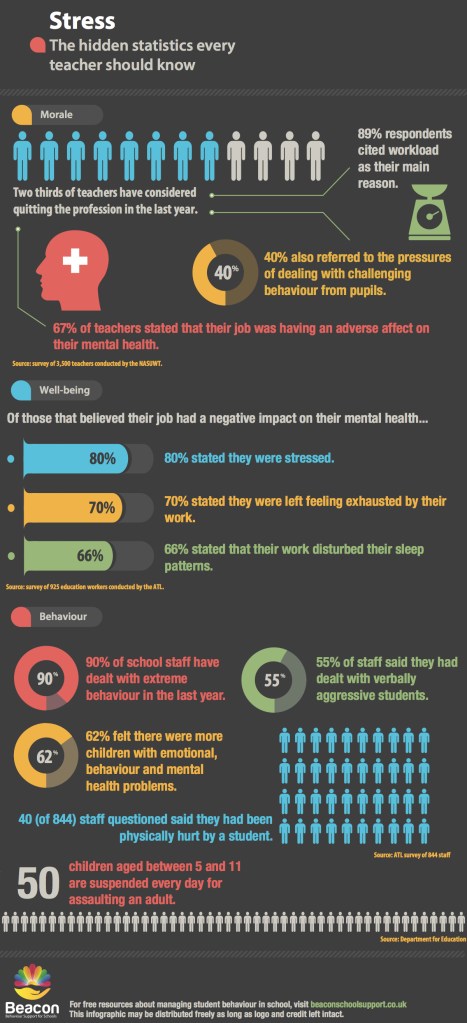
Common sources of teacher stress include:
- student behaviour (Ferguson et al., 2012)
- working conditions (Stauffer & Mason, 2013)
- lack of administrative support (Brunsting et al., 2014)
- lack of resources (O’Donnell et al., 2008)
- workload (Ferguson et al., 2012).
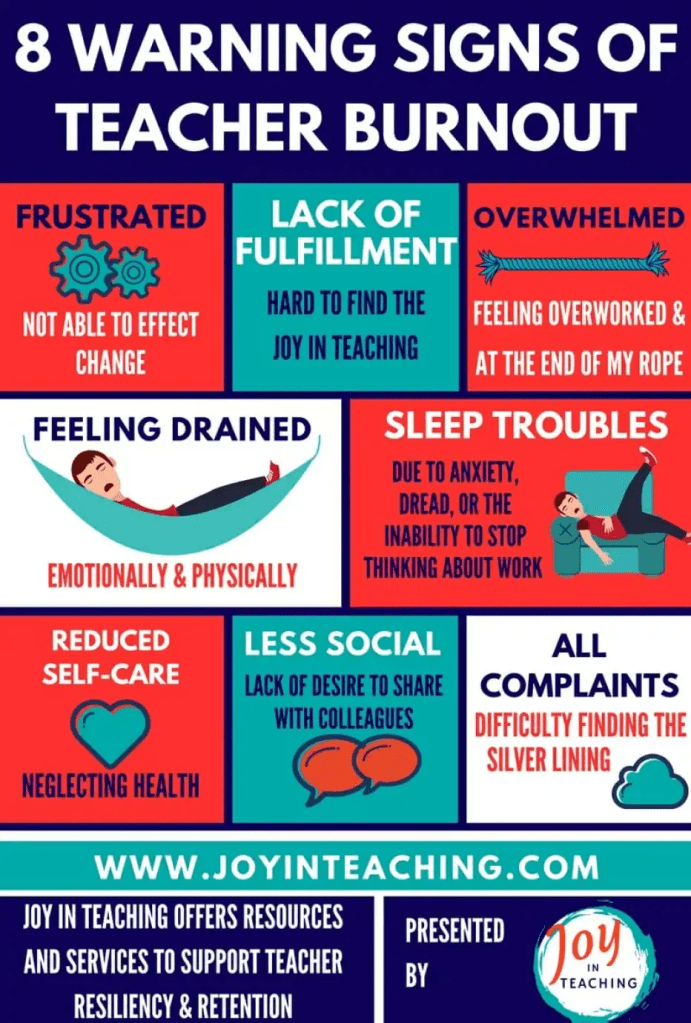
Burnout is an extreme symptom of teacher stress. It includes feeling a loss of personal accomplishment. Teachers can also experience isolation and emotional exhaustion (Maslach & Schaufeli, 1993).
Solutions
Mental health coping strategies can protect against overwhelming stress. According to Schussler (2018), these include:
- mindfulness
- a sense of efficacy
- community support
- emotional regulation
- self-care
Acknowledging mental health challenges is the first step but, unfortunately, perceived stigma hinder teachers from accessing help (Ferguson et al., 2012). In a study by Ferguson et al. (2022), seven out of the eight teachers they interviewed explicitly discussed the stigma on teacher mental health issues. They also talked about taking leave as a coping mechanism. Teachers fear judgment if they can’t cope in the classroom. They worry about being judged if they openly discuss the stress they are experiencing.
The interviews also exposed negative perceptions from teachers about other teachers. Some feel that mental health is used as an excuse by others to take time off work. They believe the real reason for their absence is professional incompetence. Clearly, this stigma is still an issue in the teaching profession. It hinders the crucial process of teachers seeking support when they need it.

Final Thoughts
Sara’s story is not unusual; it’s the quiet reality for many teachers. Educators face rising expectations and insufficient support. A persistent stigma around mental health also affects them. As a result, too many are left to struggle in silence.
The findings from the research are clear. Stress is not just part of the job. It’s a structural issue that demands systemic solutions. From unmanageable workloads to lack of administrative backing, these challenges won’t be solved by yoga sessions alone. Mindfulness and self-care have their place. However, true progress requires a cultural shift in how we talk about teacher stress. It also requires a shift in how we respond to it.
That means recognizing mental health as a legitimate and pressing concern. It means ensuring leave policies are flexible and stigma-free. And most importantly, it means creating school environments. In these environments, no teacher feels they have to choose between their well-being and their worth.
Supporting teacher mental health isn’t just an act of care. It’s a foundation for healthy schools. It helps create thriving students and supports a sustainable profession.
References
Beacon School Support. (2025). 20 eye-opening teacher stress statistics in the UK. https://beaconschoolsupport.co.uk/newsletters/stress_teaching_statistics
Brunsting, N. C., Sreckovic, M. A., & Lane, K. L. (2014). Special education teacher burnout: A synthesis of research from 1979 to 2013. Education and Treatment of Children, 37(4), 681–712. https://doi.org/10.1353/etc.2014.0032
Cedoline, A. J. (1982). Job burnout in public education: Symptoms, causes and survival skills. Teachers College Press.
Ferguson, K., Frost, L., & Hall, D. (2012). Predicting teacher stress, anxiety, and job satisfaction. Journal of Teaching and Learning, 8(1), 27–42.
Ferguson, K., James, Y., & Bourgeault, I. (2022). Teacher mental health and leaves of absence: A pilot study examining gender and care. Canadian Journal of Education, 45(2), 315–349. https://www.jstor.org/stable/10.2307/27227173
Joy in Teaching. (2025). 8 warning signs and symptoms of teacher burnout. https://joyinteaching.com/warning-signs-and-symptoms-of-teacher-burnout
Kyriacou, C. (2001). Teacher stress: Directions for future research. Educational Review, 53(1), 27–35. https://doi.org/10.1080/00131910120033628
Maslach, C., & Schaufeli, W. B. (1993). Historical and conceptual development of burnout. In W. B. Schaufeli, C. Maslach, & T. Marek (Eds.), Professional burnout: Recent developments in theory and research (pp. 1–16). Taylor & Francis.
Naghieh, A., Montgomery, P., Bonell, C. P., Thompson, M., & Aber, J. L. (2015). Organisational interventions for improving wellbeing and reducing work-related stress in teachers. Cochrane Database of Systematic Reviews, (4), CD010306. https://doi.org/10.1002/14651858.CD010306.pub2
O’Donnell, M., Lambert, R. G., & McCarthy, C. J. (2008). School poverty status, time of year, and elementary teachers’ perceptions of stress. The Journal of Educational Research, 102(2), 152–160. https://doi.org/10.3200/JOER.102.2.152-160
Schussler, D. L., Greenberg, M., DeWeese, A., Rasheed, D., DeMauro, A., Jennings, P. A., & Brown, J. (2018). Stress and release: Case studies of teacher resilience following a mindfulness-based intervention. American Journal of Education, 125(1), 1–29. https://doi.org/10.1086/699808
Selye, H. (1976). The stress of life (Rev. ed.). McGraw-Hill.
Services For Education. (2025). Top 10 tips for teacher stress. https://www.servicesforeducation.co.uk/blog/schools/top-10-tips-for-teacher-stress/
Stauffer, S. D., & Mason, E. C. M. (2013). Addressing elementary school teachers’ professional stressors: Practical suggestions for schools and administrators. Educational Administration Quarterly, 49(5), 809–837. https://doi.org/10.1177/0013161X12457179
Join the conversation
Have you ever felt overwhelmed by the emotional demands of teaching? Have you taken a mental health day—or felt like you couldn’t?
I’d love to hear your thoughts, experiences, and insights. Let’s break the silence around teacher stress and start supporting one another more openly.


 Research for Teachers
Leave a comment