

It’s the middle of a Grade 9 English lesson on Of Mice and Men, and most students are flipping through the pages, eagerly discussing George and Lennie’s relationship. One student (let’s call him Adam) sits quietly, avoiding eye contact. His quizzes are decent, and he’s never disruptive. At first glance, there’s nothing that signals a serious issue. But his minimal contributions in discussions and surface-level annotations hint that something is amiss.
Curious, you observe Adam more closely and discover he struggles with processing longer texts on his own. Traditional assessments didn’t catch this; Adam was relying on class discussions and summaries to keep up. Recognizing his hidden struggle, you introduce short guided reading tasks, one-on-one check-ins, and audio support to address his needs. Over time, his class participation and written analyses improve dramatically.
Adam’s situation underscores an important point: equity in education isn’t just about who is obviously falling behind—it’s also about discovering who might be silently struggling and using data in the broadest sense (observations, formative checks, and conversations) to tailor support.
Importance of Data-Driven Decision Making (DDDM)
- DDDM is the systematic collection, analysis, examination, and interpretation of data to inform practice (Mandinach & Jackson, 2012).
- Specifically, DDDM is comprised of six steps, including (a) collecting and (b) organizing raw data which can be converted into information; (c) analyzing and (d) summarizing information which can be transformed into usable, applicable knowledge; (e) synthesizing and (f) prioritizing the information to develop a set of options from which decision makers select a choice and reach a decision (Mandinach et al., 2006).
- Gathering student information, performing data analysis to identify areas of improvement for students, and making adjustments to future lesson plans are all part of data driven instruction (Sperry, 2022). Without this data, opportunities to identify gaps in equitable education may be missed.
What is Equitable Education?
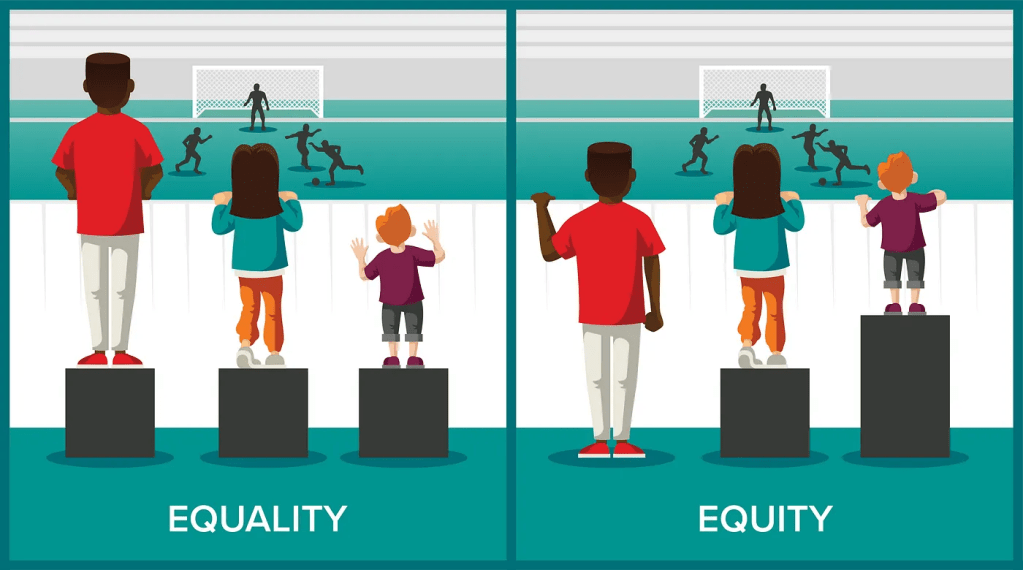
- According to the National Equity Project (2025), “educational equity means that each child receives what they need to develop to their full academic and social potential“. In other words, it means ensuring that all students receive the tools they need to succeed, not just tracking performance.
- Gonzalez (2017) defines the difference between an equal system and an equitable system: “in an “equal” system, all students are given the same resources. In an “equitable” system, resources are given to students based on their individual needs.”
Challenges
- According to Evans (2024), many struggling readers may not be immediately recognized because they have developed coping strategies, such as relying on peers or avoiding reading tasks altogether.
- According to Phillips (2023), one of the key challenges in implementing effective reading intervention programs in middle schools is the difficulty of using data to accurately identify struggling students. While evidence-based programs emphasize data-driven instruction, schools often face obstacles in collecting, interpreting, and acting on student reading data effectively.
- According to Sideridis et al.(2008), one of the primary challenges in using data to identify students who need support is the presence of teacher biases in the identification process. Teachers’ assessments are often influenced by subjective factors such as expectations, perceptions, and personal characteristics rather than purely data-driven indicators. The study found that teacher gender played a significant role, with male teachers more likely to over-identify students as having learning disabilities compared to female teachers.
Solutions
Implementing a Response to Intervention (RTI) Framework
According to Kreitz (2016), the Response to Intervention (RTI) model is an effective way to identify and support struggling readers through a tiered approach. Teachers first use initial screening assessments to detect students at risk of reading difficulties. Based on the data, students receive targeted small-group interventions (Tier 2) or individualized instruction (Tier 3) while their progress is monitored. This data-driven system ensures that support is adjusted based on student performance, preventing long-term reading failure.
Using Frequent Progress Monitoring to Drive Instruction
Regular assessment of student progress is essential for ensuring interventions are effective. Phillips (2023) emphasizes the need for quantifiable data to help teachers make informed instructional decisions. Through formative assessments such as fluency checks, comprehension quizzes, and reading inventories, educators can track student growth and adjust teaching strategies accordingly. This ensures struggling readers receive personalized support rather than a one-size-fits-all approach.
Incorporating Engaging and Culturally Relevant Reading Materials
One key to improving reading outcomes is increasing student engagement. Kreitz (2016) highlights that motivation plays a crucial role in literacy development, and struggling readers benefit when they have access to high-interest, culturally relevant texts that align with their backgrounds and experiences. Using student-centered approaches, such as choice reading, real-world texts, and interactive reading activities, fosters motivation, leading to increased reading stamina and comprehension skills. Track which approaches work; this may vary from student to student.
Conclusion
Identifying and supporting struggling readers is not just about recognizing the problem—it’s about taking action. By leveraging data-driven solutions such as the RTI framework, frequent progress monitoring, and engaging, culturally relevant reading materials, educators can provide targeted interventions that ensure every student has the opportunity to develop strong literacy skills.
However, the conversation around using data for literacy intervention is ongoing. What strategies have worked in your classroom? What challenges have you faced in identifying and supporting struggling readers?
Join the conversation! Share your experiences, insights, and questions in the comments below or connect with us on social media. Let’s work together to make literacy success accessible for all students.
References
Evans, J. (2024, August 15). Spotting Reading Difficulties: Early Indicators for Middle and High School Educators. Collaborative Classroom. https://www.collaborativeclassroom.org/blog/spotting-reading-difficulties-middle-high-school/
Gill, B., Borden, B., Hallgren, K. (2014). A conceptual framework for data-driven decision making. Mathematical Policy Research.
Gonzalez, M. (2017, February 1). What’s the difference between equity and equality in education? Inspired Ideas PreK-12. https://medium.com/inspired-ideas-prek-12/whats-the-difference-between-equity-and-equality-in-education-ef20971e7fda
Kreitz, J. (2016). Identifying and supporting struggling readers. BU Journal of Graduate Studies in Education, 8(1), 25-28.
Mandinach, E. B., & Jackson, S. S. (2012). Transforming teaching and learning through data-driven decision making. Corwin Press, https://doi.org/10.4135/9781506335568
Mandinach, E.B., Honey, M., Light, D. (2006). A Theoretical Framework for Data-Driven Decision Making. Paper presented at the annual meeting of AERA, San Francisco.
National Equity Project. (2025). Education equity definition. Retrieved from https://www.nationalequityproject.org/education-equity-definition
Phillips, D. (2023). Key features of effective reading intervention for middle school students. Association for Middle Level Education. https://www.amle.org/key-features-of-effective-reading-intervention-for-middle-school-students/
Sideridis, G. D., Antoniou, F., & Padeliadu, S. (2008). Teacher biases in the identification of learning disabilities: An application of the logistic multilevel model. Learning Disability Quarterly, 31(4), 199–209. https://doi.org/10.2307/25474652
Sperry, B. (2022). Demystifying data-driven instruction. Schoolytics. https://www.schoolytics.com/blog/2022/07/demystifying-data-driven-instruction


 Research for Teachers
Leave a comment